วันศุกร์ที่ 15 กุมภาพันธ์ พ.ศ. 2556

Bastille Day


Bastille Day is the name given in English-speaking countries to the French National Day, which is celebrated on the 14th of July each year. In France, it is formally called La Fête Nationale (French pronunciation: ​[la.fɛt.na.sjɔ'nal] ; The National Celebration) and commonly Le quatorze juillet (French pronunciation: ​[lə.ka.tɔʁz.ʒɥi'jɛ] ; the fourteenth of July). It commemorates the 1790 Fête de la Fédération, held on the first anniversary of the storming of the Bastille on 14 July 1789; the anniversary of the storming of the Bastillefortress-prison was seen as a symbol of the uprising of the modern nation, and of the reconciliation of all the French inside the constitutional monarchy which preceded the First Republic, during the French Revolution. Festivities and official ceremonies are held all over France. The oldest and largest regular military parade in Europe is held on the morning of 14 July, on the Champs-Élysées avenue in Paris in front of the President of the Republic, French officials and foreign guests.

Events and traditions of the day
The Bastille Day Military Parade opens with cadets from the École Polytechnique, Saint-Cyr, École Navale, and so forth, then other infantry troops, then motorized troops; aircraft of the Patrouille de France aerobatics team fly above. In recent times, it has become customary to invite units from France's allies to the parade; in 2004 during the centenary of the Entente Cordiale, British troops (the band of the Royal Marines, the Household flying overhead. In 2007 the German 26th Airborne Brigade led the march followed by British Royal Marines.


The president used to give an interview to members of the press, discussing the situation of the country, recent events and projects for the future. Nicolas Sarkozy, elected president in 2007, chose not to give it.

History The storming of the Bastille
Main article: Storming of the Bastille
On 19 May 1789, Louis XVI convened the Estates-General to hear their grievances. The deputies of the Third Estate representing the common people (the two others were the Catholic Church and nobility) decided to break away and form a National Assembly. On 20 June the deputies of the Third Estate took the Tennis Court Oath, swearing not to separate until a constitution had been established. They were gradually joined by delegates of the other estates; Louis XVI started to recognize their validity on 27 June. The assembly renamed itself the National Constituent Assembly on 9 July, and began to function as a legislature and to draft a constitution.

In the wake of the 11 July dismissal of Jacques Necker, the people of Paris, fearful that they and their representatives would be attacked by the royal military, and seeking to gain ammunition and gunpowder for the general populace, stormed the Bastille, a fortress-prison in Paris which had often held people jailed on the basis of lettres de cachet, arbitrary royal indictments that could not be appealed. Besides holding a large cache of ammunition and gunpowder, the Bastille had been known for holding political prisoners whose writings had displeased the royal government, and was thus a symbol of the absolutism of the monarchy. As it happened, at the time of the siege in July 1789 there were only seven inmates, none of great political significance.

When the crowd—eventually reinforced by mutinous gardes françaises—proved a fair match for the fort's defenders, Governor de Launay, the commander of the Bastille, capitulated and opened the gates to avoid a mutual massacre. However, possibly because of a misunderstanding, fighting resumed. Ninety-eight attackers and just one defender died in the actual fighting, but in the aftermath, de Launay and seven other defenders were killed, as was the 'prévôt des marchands' (roughly, mayor) Jacques de Flesselles.

Shortly after the storming of the Bastille, on 4 August feudalism was abolished and on 26 August, the Declaration of the Rights of Man and of the Citizen proclaimed.
Claude Monet, Rue Montorgueil, Paris, Festival of 30 June 1878.

The Fête de la Fédération
Main article: Fête de la Fédération
The Fête de la Fédération on the 14 July 1790 was a huge feast and official event to celebrate the uprising of the short-lived constitutional monarchy in France and what people considered the happy conclusion of the French Revolution. The event took place on the Champ de Mars, which was at the time far outside Paris. The place had been transformed on a voluntary basis by the population of Paris itself, in what was recalled as the Journée des brouettes ("Wheelbarrow Day").
A mass was celebrated by Talleyrand, bishop of Autun. The popular General Lafayette, as captain of the National Guard of Paris and confidant of the king, took his oath to the constitution, followed by the King Louis XVI. After the end of the official celebration, the day ended in a huge four-day popular feast and people celebrated with fireworks, as well as fine wine and running naked through the streets in order to display their great freedom.

Origin of the present celebration
On 30 June 1878, a feast had been arranged in Paris by official decision to honour the French Republic (the event was commemorated in a painting by Claude Monet). On 14 July 1879, another feast took place, with a semi-official aspect; the events of the day included a reception in the Chamber of Deputies, organised and presided over by Léon Gambetta, a military review in Longchamp, and a Republican Feast in the Pré Catelan. All through France, Le Figaro wrote, "people feasted much to honour the storming of the Bastille".

On 21 May 1880, Benjamin Raspail proposed a law to have "the Republic choose the 14 July as a yearly national holiday". The Assembly voted in favour of the proposal on 21 May and 8 June. The Senate approved on it 27 and 29 June, favouring 14 July against 4 August (honouring the end of the feudal system on 4 August 1789). The law was made official on 6 July 1880, and the Ministry of the Interior recommended to Prefects that the day should be "celebrated with all the brilliance that the local resources allow".[this quote needs a citation] Indeed, the celebrations of the new holiday in 1880 were particularly magnificent.

In the debate leading up to the adoption of the holiday, Henri Martin, chairman of the French Senate, addressed that chamber on 29 June 1880:

Do not forget that behind this 14 July, where victory of the new era over the ancien régime was bought by fighting, do not forget that after the day of 14 July 1789, there was the day of 14 July 1790.... This [latter] day cannot be blamed for having shed a drop of blood, for having divided the country. It was the consecration of the unity of France.... If some of you might have scruples against the first 14 July, they certainly hold none against the second. Whatever difference which might part us, something hovers over them, it is the great images of national unity, which we all desire, for which we would all stand, willing to die if necessary.

  Bastille Day Military Parade
Main article: Bastille Day Military Parade
The Bastille Day Military Parade is the French military parade that has been held on the morning of 14 July each year in Paris since 1880. While previously held elsewhere within or near the capital city, since 1918 it has been held on the Champs-Élysées, with the evident agreement of the Allies as represented in the Versailles Peace Conference, and with the exception of the period of German occupation from 1940 to 194 The parade passes down the Champs-Élysées from the Arc de Triomphe to the Place de la Concorde, where the President of the French Republic, his government and foreign ambassadors to France stand. This is a popular event in France, broadcast on French TV, and is the oldest and largest regular military parade in Europe. In some years, invited detachments of foreign troops take part in the parade and foreign statesmen attend as guests.
Smaller military parades are held in French garrison towns, including Toulon and Belfort, with local troops.

วันพฤหัสบดีที่ 24 มกราคม พ.ศ. 2556

Valentine's Day


Saint Valentine's Day, commonly known as Valentine's Day, or the Feast of Saint Valentine, is observed on February 14 each year. Today Valentine's Day is celebrated in many countries around the world, mostly in the West, although it remains a working day in many of them.
St. Valentine's Day began as a liturgical celebration of one or more early Christian saints named Valentinus. The most popular martyrology associated with Saint Valentine was that he was imprisoned for performing weddings for soldiers who were forbidden to marry and for ministering to Christians, who were persecuted under the Roman Empire; during his imprisonment, he is said to have healed the daughter of his jailer Asterius. Legend states that before his execution he wrote "from your Valentine" as a farewell to her.Today, Saint Valentine's Day is an official feast day in the Anglican Communion, as well as in the Lutheran Church.[8] The Eastern Orthodox Church also celebrates Saint Valentine's Day, albeit on July 6th and July 30th, the former date in honor of the Roman presbyter Saint Valentine, and the latter date in honor of Hieromartyr Valentine, the Bishop of Interamna (modern Terni).
The day was first associated with romantic love in the circle of Geoffrey Chaucer in the High Middle Ages, when the tradition of courtly love flourished. By the 15th century, it had evolved into an occasion in which lovers expressed their love for each other by presenting flowers, offering confectionery, and sending greeting cards (known as "valentines").[1][3] Valentine's Day symbols that are used today include the heart-shaped outline, doves, and the figure of the winged Cupid. Since the 19th century, handwritten valentines have given way to mass-produced greeting cards.


วันจันทร์ที่ 12 พฤศจิกายน พ.ศ. 2555

อาหารบำรุงสายตา


อาหารดีมีประโยชน์ต่อสุขภาพฉันใด อาหารบำรุงสายตาก็มีความจำเป็นต่อสุขภาพสายตาที่ดีฉันนั้น การมองเห็นเป็นสิ่งที่วิเศษสุดของคนเรา สุขภาพสายตาควรได้รับการดูแลอย่างดี
ด้วยการใช้ดวงตาอย่างทะนุถนอมและรู้จักดูแลบำรุงรักษาสายตาด้วยการเลือกกินอาหารที่มีสารอาหารและวิตามินบำรุงสายตา

อาหารบำรุงสายตา จะมีวิตามินเอ สารอาหารที่ชื่อว่า ลูทีน (Lutein) และซีแซนทีน (Zeaxanthin) เป็นสารอาหารสำคัญในอาหารบำรุงสายตา วิตามินเอจะได้จากอาหารจำพวก ตับไก่ ตับหมู ไข่แดง ฟักทอง ฯลฯ สำหรับสารอาหารลูทีน (Lutein) และ ซีแซนทีน(Zeaxanthin) นั้นเหมาะสำหรับคนที่ห่วงใยสุขภาพสายตาอย่างจริงจังและคนที่ทำงานโดยใช้สายตามากเช่น คนที่ต้องนั่งทำงานหน้าจอคอมพิวเตอร์เป็นเวลานานๆในแต่ละวันหรือต้องทำงานอยู่กลางแจ้งที่มีแสงแดดจ้า คนที่ต้องขับรถกลางคืนบ่อยๆที่มักจะถูกแสงไฟรถที่วิ่งสวนมาสาดเข้าตาบ่อยๆในลักษณะเดียวกับแสงไฟแฟลชจากกล้องถ่ายรูปทำให้สายตาต้องทำงานหนักเมื่อเจอแสงสว่างในลักษณะนี้

       สารอาหารลูทีน (Lutein) และซีแซนทีน (Zeaxanthin)นั้นจะอยู่ในจุดรับภาพของดวงตาคนเรา สารอาหารทั้งสองตัวนี้จะช่วยกรองแสงหรือป้องกันรังสีที่จะทำให้เกิดอันตรายต่อดวงตา นอกจากนี้ลูทีน(Lutein) และ ซีแซนทีน(Zeaxanthin)ยังช่วยปกป้องไม่ให้เซลล์ของจอประสาทตาถูกทำลาย ดังนั้นการบำรุงรักษาสายตาทำได้โดยรู้จักเลือกกินอาหารที่มีสารลูทีน(Lutein)และซีแซนทีน(Zeaxanthin)อยู่เพื่อประโยชน์ในการบำรุงสายตา

  อาหารที่มีลูทีน (Lutein) และ ซีแซนทีน(Zeaxanthin) ที่ช่วยบำรุงสายตาได้แก่อาหารจำพวกพืชผักผลไม้ที่มีสีเขียวเข้มและสีเหลืองเช่น ผักคะน้า ผักปวยเล้ง ผักโขมและข้าวโพด สารอาหารที่จำเป็นในการบำรุงสายตาควบคู่ไปกับลูทีน (Lutein) และ ซีแซนทีน (Zeaxanthin)ก็คือวิตามินเอที่ได้จากอาหารจำพวกฟักทอง
แครอท ผักตำลึง ตับหมู มะละกอ มะม่วงสุก
ผักบุ้ง ฯลฯ นอกจากนี้สารอาหารทั้งสองตัวนี้ยังช่วยลดความเสี่ยงในการเป็นโรคต้อกระจก(Cataracts) โรคกระจกตาเสื่อม(AMD) มะเร็งเต้านมและโรคหลอดเลือดหัวใจอีกด้วย

   การดูแลรักษาสุขภาพดวงตาให้มีสุขภาพดี นอกจากจะรู้จักเลือกกินอาหารบำรุงสายตาที่มีสารลูทีน (Lutein) ซีแซนทีน (Zeaxanthin) และวิตามินเอแล้วยังมีสิ่งที่ต้องทำควบคู่กันไปเพื่อให้เกิดผลดีต่อสุขภาพของสายตานั่นคือ การปรับเปลี่ยนพฤติกรรมการใช้สายตาในการทำงานเช่น ใช้แผ่นกรองแสงกับจอคอมพิวเตอร์และปรับลดระดับแสงสว่างจากจอคอมพิวเตอร์ให้พอเหมาะอย่าให้สว่างจ้ามากเกินไป เมื่อทำงานที่ต้องใช้สายตามากๆเป็นเวลานานให้รู้จักหยุดพักสายตาบ้างสัก 3-5 นาทีแล้วค่อยกลับไปทำงานต่อ เมื่อต้องทำงานกลางแจ้งเป็นเวลานานควรสวมแว่นกันแดดเพื่อลดปริมาณแสงที่จะเข้ามายังตาของเรา

อาหารบำรุงสายตาช่วยให้ดวงตาได้รับสารอาหารที่มีประโยชน์ต่อดวงตาและการปรับพฤติกรรมการทำงานที่ต้องใช้สายตามากๆจะเป็นการป้องกันและช่วยถนอมรักษาดวงตา หากทำทั้งสองอย่างไปพร้อมกันก็เหมือนกับการบำรุงรักษาสายตาจากภายใน (กินอาหารบำรุงสายตา) และป้องกันอันตรายรบกวนกับสายตาจากภายนอก (ปรับพฤติกรรมการใช้สายตา) ซึ่งจะมีผลช่วยถนอมและรักษาดวงตาให้อยู่กับเราไปได้อีกนานเท่านาน


วันอาทิตย์ที่ 16 กันยายน พ.ศ. 2555

แม่น้ำแม่กลอง


แม่น้ำแม่กลอง เป็นแม่น้ำสำคัญสายหนึ่งในภาคตะวันตก เกิดจากแม่น้ำแควใหญ่และแควน้อย ไหลมาบรรจบกันที่ตำบลปากแพรก อำเภอเมือง จังหวัดกาญจนบุรี ไหลผ่านจังหวัดราชบุรี สมุทรสงคราม และไหลลงสู่ปากอ่าวไทยที่อำเภอเมือง จังหวัดสมุทรสงคราม มีความยาวประมาณ 132 กิโลเมตร พื้นที่รับน้ำที่ปากแม่น้ำแม่กลอง 30,106 ตารางกิโลเมตร
มีพื้นที่ลุ่มน้ำ 30,837 ตร.กม. หรือ 19.45 ล้านไร่ ครอบคลุมพื้นที่ 8 จังหวัด ได้แก่ กาญจนบุรี ราชบุรี สมุทรสงคราม บางส่วนของจ.สุพรรณบุรี นครปฐม สมุทรสาคร อุทัยธานี และ ตาก ปริมาณน้ำท่ารายปีเฉลี่ย 7,973 ล้าน ลบ.ม.
ลุ่มน้ำแม่กลองแบ่งออก เป็นลุ่มน้ำย่อย 14 ลุ่มน้ำย่อย ได้แก่ แม่น้ำแควใหญ่ (1,445 ตร.กม.) ห้วยแม่ละมุง (910 ตร.กม.) ห้วยแม่จัน (862 ตร.กม.) แม่น้ำแควใหญ่ตอนกลาง (3,380 ตร.กม.) แม่น้ำแควใหญ่ตอนล่าง (4,094 ตร.กม.) ห้วยขาแข้ง (2,320 ตร.กม.) ห้วยตะเพียน (2,627 ตร.กม.) แม่น้ำแควน้อยตอนบน (3,947 ตร.กม.) ห้วยเขย็ง (1,015 ตร.กม.) ห้วยแม่น้ำน้อย (947 ตร.กม.) ห้วยบ้องตี้ (477 ตร.กม.) แม่น้ำแควน้อยตอนกลาง (2,042 ตร.กม.) ลำภาชี (2,453 ตร.กม.) ทุ่งราบแม่น้ำแม่กลอง (4,318 ตร.กม.)

วันพฤหัสบดีที่ 23 สิงหาคม พ.ศ. 2555

แชงเก้นวีซ่า (Schengen Visa)

Schengen Visa นั้นใช้ได้กับประเทศแถบยุโรปที่เป็นสมาชิก Schengen Visa เหมาะสำหรับนักท่องเที่ยว ที่เดินทางไปเที่ยวยุโรป หลายประเทศต่อเนื่องกันในทริปเดียว โดยสามารถยื่นคำร้องขอวีซ่า แบบเดินทางเข้า - ออกครั้งเดียว หรือเดินทางเข้า - ออกหลายครั้งก็ได้ แต่ทั้งนี้รวมเวลาที่พำนักทั้งหมดแล้ว ต้องไม่เกิน 90 วัน ภายในระยะเวลา 6 เดือน โดยเริ่มนับตั้งแต่วันแรกที่เดินทางเข้าประเทศในกลุ่มสัญญาเชงเก็น


การทำ Schengen Visa จะทำให้นักท่องเที่ยวไม่ต้องเสียเวลายื่นวีซ่าขอเข้าประเทศ กับทุกๆ ประเทศที่จะเดินทางเข้าไปเที่ยว มีเพียง Schengen Visa ก็สามารถเข้าได้ทุกประเทศที่เป็นสมาชิก Schengen สำหรับ Schengen Visa นั้น ให้ยื่นคำร้องขอวีซ่าต่อสถานทูตของประเทศที่ จะเดินทางเข้าไปเป็นประเทศแรกที่ผู้เดินทาง เดินทางไปถึงยุโรป (ตัวอย่างเช่น เดินทางไป อิตาลี - สวิส - ฝรั่งเศส ประเทศที่จะออก Schengen Visa ให้คือ ประเทศ อิตาลี)

ออสเตรีย
เบลเยี่ยม
เดนมาร์ก
ฟินแลนด์
ฝรั่งเศส
เยอรมัน
กรีซ
ไอซ์แลนด์
อิตาลี
ลักเซมเบิร์ก
เนเธอร์แลนด์
นอร์เวย์
โปรตุเกส
สเปน
สวีเดน


วันอังคารที่ 31 กรกฎาคม พ.ศ. 2555

Horse


The horse (Equus ferus caballus) is one of two extant subspecies of Equus ferus, or the wild horse. It is an odd-toed ungulate mammal belonging to the taxonomic familyEquidae. The horse has evolved over the past 45 to 55 million years from a small multi-toed creature into the large, single-toed animal of today. Humans began to domesticatehorses around 4000 BC, and their domestication is believed to have been widespread by 3000 BC. Horses in the subspecies caballus are domesticated, although some domesticated populations live in the wild as feral horses. These feral populations are not true wild horses, as this term is used to describe horses that have never been domesticated, such as the endangered Przewalski's Horse, a separate subspecies, and the only remaining true wild horse. There is an extensive, specialized vocabulary used to describe equine-related concepts, covering everything from anatomy to life stages, size,colors, markings, breeds, locomotion, and behavior.
Horses' anatomy enables them to make use of speed to escape predators and they have a well-developed sense of balance and a strong fight-or-flight instinct. Related to this need to flee from predators in the wild is an unusual trait: horses are able to sleep both standing up and lying down. Female horses, called mares, carry their young for approximately 11 months, and a young horse, called a foal, can stand and run shortly following birth. Most domesticated horses begin training under saddle or in harnessbetween the ages of two and four. They reach full adult development by age five, and have an average lifespan of between 25 and 30 years.
Horse breeds are loosely divided into three categories based on general temperament: spirited "hot bloods" with speed and endurance; "cold bloods", such as draft horses and some ponies, suitable for slow, heavy work; and "warmbloods", developed from crosses between hot bloods and cold bloods, often focusing on creating breeds for specific riding purposes, particularly in Europe. There are more than 300 breeds of horses in the world today, developed for many different uses.
Horses and humans interact in a wide variety of sport competitions and non-competitive recreational pursuits, as well as in working activities such as police work, agriculture, entertainment, and therapy. Horses were historically used in warfare, from which a wide variety of riding and driving techniques developed, using many different styles ofequipment and methods of control. Many products are derived from horses, including meat, milk, hide, hair, bone, and pharmaceuticals extracted from the urine of pregnant mares. Humans provide domesticated horses with food, water and shelter, as well as attention from specialists such as veterinarians and farriers.


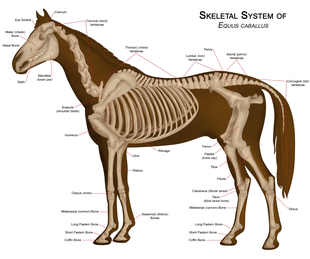
Skeletal systemDiagram of a horse skeleton with major parts labeled.


The horse skeleton averages 205 bones. A significant difference between the horse skeleton and that of a human is the lack of a collarbone—the horse's forelimbs are attached to the spinal column by a powerful set of muscles, tendons, and ligaments that attach the shoulder blade to the torso. The horse's legs and hooves are also unique structures. Their leg bones are proportioned differently from those of a human. For example, the body part that is called a horse's "knee" is actually made up of the carpal bones that correspond to the human wrist. Similarly, the hock contains bones equivalent to those in the human ankle and heel. The lower leg bones of a horse correspond to the bones of the human hand or foot, and the fetlock (incorrectly called the "ankle") is actually the proximal sesamoid bones between the cannon bones (a single equivalent to the human metacarpal or metatarsal bones) and the proximal phalanges, located where one finds the "knuckles" of a human. A horse also has no muscles in its legs below the knees and hocks, only skin, hair, bone, tendons, ligaments, cartilage, and the assorted specialized tissues that make up the hoof.


วันอังคารที่ 19 มิถุนายน พ.ศ. 2555

เขากระโจม

เป็นยอดเขาสุดเขตชายแดนระหว่างไทย-พม่า ตั้งอยู่ในแนวเทือกเขาตะนาวศรี มีความสูงจากระดับน้ำทะเลประมาณ 1,045 เมตร บริเวณนี้เป็นที่อาศัยของของชุมชนชาวกะเหรี่ยงซึ่งอพยพมาจากเมืองทวายประเทศพม่า ชาวกะเหรี่ยงเรียกยอดเขานี้ว่า "เขาลันดา" ซึ่งหมายถึง ภูเขาที่มีที่ราบ ส่วนชื่อ "เขากระโจม" นั้นได้รับฉายามาจากคนไทยที่เข้าไปทำเหมืองแร่ แล้วมองเห็นยอดเขาดูดล้ายกระโจมของชนเผ่าอินเดียนแดงนั่นเองที่นี่นับเป็นจุดชมทะเลหมอก ทิวทัศน์ขุนเขาฝั่งพม่า และชมพระอาทิตย์ขึ้นพร้อมแสงแรกแห่งวันที่สวยที่สุดในสวนผึ้ง
การเดินทางขึ้นเขากระโจมค่อนข้างลำบากเพราะเส้นทางลาดชันมากมีเพียงรถขับเคลื่อนสี่ล้อเท่านั้นที่จะพาเราขึ้นสู่ยอดเขาได้ ใครอยากขึ้นไปต้องตื่นแต่เช้ามืด ใช้เวลาเดินทางประมาณ 45 นาทีถึง 1 ชั่วโมง (ขึ้นอยู่กับฤดูกาลและความชำนาญของคนขับ) ระหว่างทางจะได้ชมทิวทัศน์ของผืนป่าเขียวขจีรอบด้านและเห็นสายหมอกเคลื่อนตัวอ้อยอิ่งอยู่เหนือหุบเขา เมื่อถึงยอดเขาก็จะเห็นทิวทัศน์ของเทือกเขาตะนาวศรีที่ทอดตัวยาวไปถึงชายแดนประเทศเพื่อนบ้าน ท่ามกลางทะเลหมอกในยามเช้าและอากาศที่หนาวเย็นจับใจ ข้างบนมีลานกางเต้นท์สำหรับนักท่องเที่ยว แต่ไม่มีสิ่งอำนวยความสะดวกอื่นๆนอกจากห้องน้ำ
ขากลับจากชมทะเลหมอกแนะนำให้แวะเที่ยวน้ำตกผาแดงน้ำตกธรรมชาติที่ซ่อนตัวอยู่ในราวป่า มีต้นน้ำมาจากห้วยลันดาโดดเด่นด้วยผาหินสีแดงสมชื่อ ในอดีตเคยเป็นแหล่งน้ำที่ใช้สำหรับร่อนแร่ดีบุกและวุลแฟรม หากเดินทางไปเที่ยวในช่วงฤดูฝนให้ระวังตัวทากด้วย


Dora Maar au Chat


Dora Maar au Chat (Dora Maar with Cat) is a 1941 painting by Pablo Picasso. It depicts Dora Maar, the
painter's lover, seated on a chair with a small cat perched on her shoulders. This work is one of the world's most expensive paintings.

History

he canvas (50 ½ by 37 ½ inches / 128.3 cm by 95.3 cm) was one of many portraits of Dora Maar painted by Pablo Picasso over their nearly decade-long relationship. Picasso fell in love with the 29-year old Maar at the age of 55 and soon began living with her. This painting was done during the year 1941, when the Nazis were occupying France. In the 1940s, the painting was obtained by Chicago collectors Leigh and Mary Block. They sold the painting in 1963 After that, the painting was never shown until the 21st century.
During 2005 and 2006, Dora Maar au Chat, then owned by the Gidwitz family of Chicago, was shown worldwide as part of Sotheby's exhibitions in London, Hong Kong and New York. It came up for sale in an auction of Impressionist/Modern works held at Sotheby's on May 3, 2006 in New York and making it the second-highest price ever paid for a painting at auction. An anonymous Russian bidder present at the New York auction won the work with a final bid of US$95,216,000, well exceeding the pre-auction US$50 million estimates.
The identity of the bidder, who spent more than US$100 million in total, and purchased an 1883 Monet seascape and a 1978 Chagall in addition to the Picasso, was a topic of much speculation. Apparently a novice bidder, though possibly acting as an agent for a more well-known collector, the anonymous buyer may have been unknown at the start of the auction even to Sotheby's officials.As of mid-2007, the ownership of the Dora Maar au Chat is still unknown to the general public, although rumors have focused on the Georgian mining magnate Bidzina (Boris) Ivanishvili, who sold his Moscow bank a week before the auction for $550 m. He resides at a large house built into a rock bluff in his native Republic of Georgia.


Descriptions of painting

Dora Maar au Chat presents the artist's most mysterious and challenging mistress regally posed three-quarter length in a large wooden chair with a small black cat perched behind her in both an amusing and menacing attitude. The faceted planes of her body and richly layered surface of brushstrokes impart a monumental and sculptural quality to this portrait. The painting is also remarkable for its brilliance of colour and the complex and dense patterning of the model's dress. The powerful figure is set in a dramatic, yet simple setting composed of a vertiginously inclined plane of wooden floorboards and shallow interior space that is arranged in a manner reminiscent of Picasso’s earliest manipulations of space in a cubist manner.
Dora Maar au Chat is one of Picasso’s most valued depictions of his lover and artistic companion. Their partnership had been one of intellectual exchange and intense passion—Dora was an artist, spoke Picasso’s native Spanish, and shared his political concerns. She even assisted with the execution of the monumental Guernica and produced the only photo-documentary of the work in progress. She was an intellectual force – a characteristic that both stimulated and challenged Picasso and her influence on him resulted in some of his most powerful and daring portraits of his 75-year career. Among the best of them are the oils completed during the late 1930s and early 1940s, when Picasso’s art resonated with the drama and emotional upheaval of the era and which Dora came to personify. The luminous Dora Maar au Chat was painted in 1941, at the beginning of the Second World War in France .
Maar was one of the most influential figures in Picasso’s life during their relationship and she also became his primary model. By the time he painted the present picture he had incorporated Dora Maar’s image into countless versions of this motif. During the occupation of Paris by the Nazis, and as tension mounted in their relationship, the artist would express his frustration by furiously abstracting her image, often portraying her in tears. While the present portrait might seem a departure from Picasso's more hostile depictions of this model, it may be one of his most brilliant and biting provocations of his Weeping Woman. Picasso once likened Maar’s allure and temperament to that of an “Afghan cat”, and the cat in this picture is laden with significance. In the history of art, the pairing of cats and women was an allusion to feminine wiles and sexual aggression, as exemplified in Manet’s notorious Olympia. It is also interesting to consider that the artist has paid particular attention to the sharp, talon-like nails on the long fingers of his model. In life Maar’s well-manicured hands were one of her most beautiful and distinctive features, and here they have taken on another, more violent characteristic.
In addition to being a rare, three-quarter length portrait of Dora Maar, the present work is also a generous and painterly composition with an extraordinary attention to detail. The artist used an extraordinarily vibrant palette in his rendering of the angles of the chair and the patterning of Maar’s dress. The most embellished and symbolic element of the sitter’s wardrobe in this picture is her hat, Maar’s most famous accessory and signifier of her involvement in the Surrealist movement. Ceremoniously placed atop her head like a crown, it is festooned with colourful plumes and outlined with a band of vibrant red. Larger than life, an impression enhanced by her vibrant body that cannot be confined by the boundaries of the chair, Maar looms in this picture like a pagan goddess seated on her throne.


วันพฤหัสบดีที่ 31 พฤษภาคม พ.ศ. 2555

Diana, Princess of Wales


Diana, Princess of Wales (Diana Frances;[N 1] née Spencer; 1 July 1961 – 31 August 1997), was the first wife of Charles, Prince of Wales, whom she married on 29 July 1981, and member of the British Royal Family[2]. She was also well known for her fund-raising work for international charities, and an eminent celebrity of the late 20th century. Her wedding to Charles, heir to the British throne and those of the 16 Commonwealth realms, was held at St Paul's Cathedral and seen by a global television audience of over 750 million. While married she bore the courtesy titles Princess of Wales, Duchess of Cornwall, Duchess of Rothesay, Countess of Chester and Baroness of Renfrew. The marriage produced two sons, the princes William and Harry,[3] currently second and third in line to the throne, respectively.


Diana was born into an aristocratic English family with royal ancestry and became a public figure with the announcement of her engagement to Prince Charles. Diana also received recognition for her charity work and for her support of the International Campaign to Ban Landmines. From 1989, she was the president of the Great Ormond Street Hospital for children, in addition to dozens of other charities. She remained the object of worldwide media scrutiny during and after her marriage, which ended in divorce on 28 August 1996. Media attention and public mourning were considerable after her death in a car crash in Paris on 31 August 1997.

วันพฤหัสบดีที่ 24 พฤษภาคม พ.ศ. 2555

Wet season


The wet season, or rainy season, is the time of year, covering one or more months, when most of the average annual rainfall in a region occurs. The term green season is also sometimes used as a euphemism by tourist authorities. Areas with wet seasons are dispersed across portions of the tropics and subtropics. Under the Koppen climate classification, for tropical climates, a wet season month is defined as a month where average precipitation is 60 millimetres (2.4 in) or more.  In contrast to areas with savanna climates and monsoon regimes, mediterranean climates have wet winters and dry summers. Tropical rainforests technically do not have dry or wet seasons, since their rainfall is equally distributed throughout the year. Some areas with pronounced rainy seasons will see a break in rainfall mid-season, when the intertropical convergence zone or monsoon trough moves poleward of their location during the middle of the warm season.
When the wet season occurs during a warm season, or summer, precipitation falls mainly during the late afternoon and early evening hours. The wet season is a time when air quality improves, freshwater quality improves, and vegetation grows substantially, leading to crop yields late in the season. Floods cause rivers to overflow their banks, and some animals to retreat to higher ground. Soil nutrients diminish and erosion increases. The incidence of malaria increases in areas where the rainy season coincides with high temperatures. Animals have adaptation and survival strategies for the wetter regime. Often, the previous dry season leads to food shortages in the wet season, as the crops have yet to mature.

Character of the rainfall
In areas where the heavy rainfall is associated with a wind shift, the wet season becomes known as the monsoon. Since rainfall during the wet season is predominantly due to daytime heating which leads to diurnal thunderstorm activity within a pre-existing moist airmass, rainfall is mainly focused during the late afternoon and early evening hours within savannah and monsoon regimes. This also leads to much of the total rainfall each day falling during the initial minutes of the downpour, before the storms mature into their stratiform stage.[8] While most locations have only one wet season, areas of the tropics can experience two wet seasons as the monsoon trough, or Intertropical Convergence Zone, can pass over locations in the tropics twice per year. Since rain forests have equitable rainfall throughout the year, they do not technically have a wet season.
The situation is different for locations within the Mediterranean climate regime. In the western United States, during the cold season from September through May, extratropical cyclones from the Pacific ocean move inland into the region due to a southward migration of the jet stream during the cold season. This shift in the jet stream brings much of the annual precipitation to the region, and also brings the potential for heavy rain and strong low pressure systems. The peninsula of Italy experiences very similar weather to the western United States in this regard


Areas affected
Areas with a savanna climate in Sub-Saharan Africa, such as Ghana, Burkina Faso, Darfur, Eritrea, Ethiopia, and Botswana have a distinct rainy season. Also within the savannah climate regime, Florida and East Texas have a rainy season. Monsoon regions include southeast Asia (including Indonesia and Philippines), northern sections of Australia's North, Polynesia, Central America,western and southern Mexico, the Desert Southwest of the United States, southern Guyana, portions of northeast Brazil.
Northern Guyana experiences two wet seasons: one in late spring and the other in early winter. In western Africa, there are two rainy seasons across southern sections with only one across the north. Within the Mediterranean climate regime, the west coast of the United States and the Mediterranean coastline of Italy, Greece, and Turkey experience a wet season in the winter months. Similarly, the wet season in the Negev desert of Israel extends from October through May. At the boundary between the Mediterranean and monsoon climates lies the Sonoran desert, which receives the two rainy seasons associated with each climate regime. The wet season is known by many different local names throughout the world. For example, the wet season period of the year in Mexico is known as storm season, with other tropical locations across the globe giving the wet season period of the year in the area they live a name in the local language of the area. Arguably, the most notable example of this is found in the list of names given to the various short "seasons" of the year by the Aboriginal tribes of Northern Australia: the name given to the wet season typically experienced in Northern Australia from December to March by the various Aboriginal tribes living in the region is Gudjewg. The precise meaning of the word is fairly disputable, although it's widely accepted to relate to the severe thunderstorms, flooding, and abundant vegetation growth commonly experienced at this time.


The wet season, or rainy season, is the time of year, covering one or more months, when most of the average annualrainfall in a region occurs. The term green season is also sometimes used as a euphemism by tourist authorities.Areas with wet seasons are dispersed across portions of the tropics and subtropics. Under the Koppen climate classification, for tropical climates, a wet season month is defined as a month where average precipitation is 60 millimetres (2.4 in) or more.  In contrast to areas with savanna climates and monsoon regimes, mediterranean climates have wet winters and dry summers. Tropical rainforests technically do not have dry or wet seasons, since their rainfall is equally distributed throughout the year. Some areas with pronounced rainy seasons will see a break in rainfall mid-season, when the intertropical convergence zone or monsoon trough moves poleward of their location during the middle of the warm season.[6]
When the wet season occurs during a warm season, or summerprecipitation falls mainly during the late afternoon and early evening hours. The wet season is a time when air quality improves, freshwater quality improves, and vegetation grows substantially, leading to crop yields late in the season. Floods cause rivers to overflow their banks, and some animals to retreat to higher ground. Soil nutrients diminish and erosion increases. The incidence of malaria increases in areas where the rainy season coincides with high temperatures. Animals have adaptation and survival strategies for the wetter regime. Often, the previous dry season leads to food shortages in the wet season, as the crops have yet to mature.

วันอาทิตย์ที่ 29 เมษายน พ.ศ. 2555

Durian


The durian is a large, spiky fruit, native to the tropical rainforests of South-East Asia - where is is known as "the king of the fruits".
It is known to those who hate it for its penetrating, powerful smell - and to those who love it for its wonderful taste.


Seeds
The durian - for whatever reason - has very large seeds - too large to pass through the guts of many creatures - and this rules out many potential seed distribution vectors.
The durian seed relies upon being discarded after its fruit is eaten (much like a mango pit) - and the raw seeds contain toxins that are effective at discouraging most of those who would try eating them.


Barrier
Many fruit "prefer" to be eaten by birds (or fruit bats) - since these represent some of the best long- distance transportation vectors.
Some fruit actively discourage being eaten by creatures such as large mammals - using toxins. However some fruit also do not seem to mind being eaten by large mammals.
Among these are a number of tropical fruit - bananas, rambutan, mangoes, papaya, pomegranates, organges and guava.
However many of these fruit face a difficult problem - how to make themselves attractive to animals without also becoming the prey of all manner of insects (who do not represent a very attractive vector for their seeds).
Some take to poisons - strong enough to deter insects, but easily dealt with by the liver of a large animal.
Others have taken to using a protective barrier - thick enough to discourage insects - but removed easily enough removed by a sufficiently large creature.
Bananas, oranges, rambutan, mangoes, pomegranates, jackfruit and breadfruit have adopted the "barrier" solution - with some success.
However none of them have taken the approach of using a physical barrier to the same heights that the durian has.
The durian doesn't just have a skin: its flesh and seeds are secured inside a well-defended fortress. Durian rind is not just impenetrable to insects - the innumerable sharp spikes also represent a defense against the beaks of birds, rodents - and all manner of small creatures.
However the durian's rind is also self-opening - when the durian is ripe it cracks along internal fault lines, and starts to open all by itself.
The practiced eye can sometimes make out these "lines of structural weakness" by the effect they have on the spines on the outer shell - though they can sometimes be difficult to identify.

วันอาทิตย์ที่ 18 มีนาคม พ.ศ. 2555


History

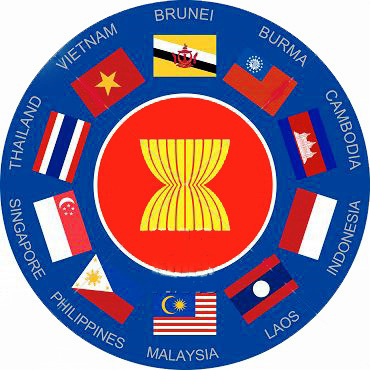
ASEAN was preceded by an organisation called the Association of Southeast Asia, commonly called ASA, an alliance consisting of the Philippines, Malaysia and Thailand that was formed in 1961. The bloc itself, however, was established on 8 August 1967, when foreign ministers of five countries – Indonesia, Malaysia, the Philippines, Singapore, and Thailand – met at the Thai Department of Foreign Affairs building in Bangkok and signed the ASEAN Declaration, more commonly known as the Bangkok Declaration. The five foreign ministers – Adam Malik of Indonesia, Narciso Ramos of the Philippines, Abdul Razak of Malaysia, S. Rajaratnam of Singapore, and Thanat Khoman of Thailand – are considered the organisation's Founding Fathers.
The motivations for the birth of ASEAN were so that its members’ governing elite could concentrate on nation building, the common fear of communism, reduced faith in or mistrust of external powers in the 1960s, and a desire for economic development; not to mention Indonesia’s ambition to become a regional hegemon through regional cooperation and the hope on the part of Malaysia and Singapore to constrain Indonesia and bring it into a more cooperative framework.
Papua New Guinea was accorded Observer status in 1976 and Special Observer status in 1981. Papua New Guinea is a Melanesian state. ASEAN embarked on a program of economic cooperation following the Bali Summit of 1976. This floundered in the mid-1980s and was only revived around 1991 due to a Thai proposal for a regional free trade area. The bloc grew when Brunei Darussalam became the sixth member on 8 January 1984, barely a week after gaining independence on 1 January

Continued expansion

On 28 July 1995, Vietnam became the seventh member. Laos and Myanmar (Burma) joined two years later on 23 July 1997. Cambodia was to have joined together with Laos and Burma, but was deferred due to the country's internal political struggle. The country later joined on 30 April 1999, following the stabilisation of its government.
During the 1990s, the bloc experienced an increase in both membership and drive for further integration. In 1990, Malaysia proposed the creation of an East Asia Economic Caucus comprising the then members of ASEAN as well as the People's Republic of China, Japan, and South Korea, with the intention of counterbalancing the growing influence of the United States in the Asia-Pacific Economic Cooperation (APEC) and in the Asian region as a whole. This proposal failed, however, because of heavy opposition from the United States and Japan. Despite this failure, member states continued to work for further integration and ASEAN Plus Three was created in 1997.
In 1992, the Common Effective Preferential Tariff (CEPT) scheme was signed as a schedule for phasing tariffs and as a goal to increase the region’s competitive advantage as a production base geared for the world market. This law would act as the framework for the ASEAN Free Trade Area. After the East Asian Financial Crisis of 1997, a revival of the Malaysian proposal was established in Chiang Mai, known as the Chiang Mai Initiative, which calls for better integration between the economies of ASEAN as well as the ASEAN Plus Three countries (China, Japan, and South Korea).
Aside from improving each member state's economies, the bloc also focused on peace and stability in the region. On 15 December 1995, the Southeast Asian Nuclear-Weapon-Free Zone Treaty was signed with the intention of turning Southeast Asia into a Nuclear-Weapon-Free Zone. The treaty took effect on 28 March 1997 after all but one of the member states have ratified it. It became fully effective on 21 June 2001, after the Philippines ratified it, effectively banning all nuclear weapons in the region.

Satellite image of the 2006 haze over Borneo
East Timor submitted a letter of application to be the eleventh member of ASEAN at the summit in Jakarta in March 2011. Indonesia has shown a warm welcome to East Timor

Environment and democracy

At the turn of the 21st century, issues shifted to involve a more environmental perspective. The organisation started to discuss environmental agreements. These included the signing of the ASEAN Agreement on Transboundary Haze Pollution in 2002 as an attempt to control haze pollution in Southeast Asia. Unfortunately, this was unsuccessful due to the outbreaks of the 2005 Malaysian haze and the 2006 Southeast Asian haze. Other environmental treaties introduced by the organisation include the Cebu Declaration on East Asian Energy Security, the ASEAN Wildlife Enforcement Network (ASEAN-WEN) in 2005, and the Asia-Pacific Partnership on Clean Development and Climate, both of which are responses to the potential effects of climate change. Climate change is of current interest.
Through the Bali Concord II in 2003, ASEAN has subscribed to the notion of democratic peace, which means all member countries believe democratic processes will promote regional peace and stability. Also, the non-democratic members all agreed that it was something all member states should aspire to.
The leaders of each country, particularly Mahathir Mohamad of Malaysia, also felt the need to further integrate the region. Beginning in 1997, the bloc began creating organisations within its framework with the intention of achieving this goal. ASEAN Plus Three was the first of these and was created to improve existing ties with the People's Republic of China, Japan, and South Korea. This was followed by the even larger East Asia Summit, which included these countries as well as India, Australia, and New Zealand. This new grouping acted as a prerequisite for the planned East Asia Community, which was supposedly patterned after the now-defunct European Community. The ASEAN Eminent Persons Group was created to study the possible successes and failures of this policy as well as the possibility of drafting an ASEAN Charter.
In 2006, ASEAN was given observer status at the United Nations General Assembly.  As a response, the organisation awarded the status of "dialogue partner" to the United Nations.Furthermore, on 23 July that year, José Ramos-Horta, then Prime Minister of East Timor, signed a formal request for membership and expected the accession process to last at least five years before the then-observer state became a full member.
In 2007, ASEAN celebrated its 40th anniversary since its inception, and 30 years of diplomatic relations with the United States. On 26 August 2007, ASEAN stated that it aims to complete all its free trade agreements with China, Japan, South Korea, India, Australia and New Zealand by 2013, in line with the establishment of the ASEAN Economic Community by 2015.In November 2007 the ASEAN members signed the ASEAN Charter, a constitution governing relations among the ASEAN members and establishing ASEAN itself as an international legal entity.[citation needed] During the same year, the Cebu Declaration on East Asian Energy Security was signed in Cebu on 15 January 2007, by ASEAN and the other members of the EAS (Australia, People's Republic of China, India, Japan, New Zealand, South Korea), which promotes energy security by finding energy alternatives to conventional fuels.[citation needed]
On 27 February 2009 a Free Trade Agreement with the ASEAN regional block of 10 countries and New Zealand and its close partner Australia was signed, it is estimated that this FTA would boost aggregate GDP across the 12 countries by more than US$48 billion over the period 2000–2020

The ASEAN way

In the 1960s, the push for decolonisation promoted the sovereignty of Indonesia and Malaysia among others. Since nation building is often messy and vulnerable to foreign intervention, the governing elite wanted to be free to implement independent policies with the knowledge that neighbours would refrain from interfering in their domestic affairs. Territorially small members such as Singapore and Brunei were consciously fearful of force and coercive measures from much bigger neighbours like Indonesia and Malaysia. "Through political dialogue and confidence building, no tension has escalated into armed confrontation among ASEAN member countries since its establishment more than three decades ago".
The ASEAN way can be traced back to the signing of the Treaty of Amity and Cooperation in Southeast Asia. "Fundamental principles adopted from this included:
mutual respect for the independence, sovereignty, equality, territorial integrity, and national identity of all nations;
the right of every State to lead its national existence free from external interference, subversion or coercion;
non-interference in the internal affairs of one another;
settlement of differences or disputes by peaceful manner;
renunciation of the threat or use of force; and
effective cooperation among themselves".
On the surface, the process of consultations and consensus is supposed to be a democratic approach to decision making, but the ASEAN process has been managed through close interpersonal contacts among the top leaders only, who often share a reluctance to institutionalise and legalise co-operation which can undermine their regime's control over the conduct of regional co-operation. Thus, the organisation is chaired by the secretariat.
All of these features, namely non-interference, informality, minimal institutionalisation, consultation and consensus, non-use of force and non-confrontation have constituted what is called the ASEAN Way. This ASEAN Way has recently proven itself relatively successful in the settlements of disputes by peaceful manner realm, with Chinese and ASEAN officials agreeing to draft guidelines ordered to avert tension in the South China Sea, an important milestone ending almost a decade of deadlock.
Despite this success, some academics continue to argue that ASEAN's non-interference principle has worsened efforts to improve in the areas of Burma, human rights abuses and haze pollution in the region. Meanwhile, with the consensus-based approach, every member in fact has a veto and decisions are usually reduced to the lowest common denominator. There has been a widespread belief that ASEAN members should have a less rigid view on these two cardinal principles when they wish to be seen as a cohesive and relevant community.


วันพุธที่ 14 มีนาคม พ.ศ. 2555


Franklin Delano Roosevelt Memorial


The Franklin Delano Roosevelt Memorial is a presidential memorial dedicated to the memory of U.S. President Franklin Delano Roosevelt and to the era he represents. For the memorial's designer, landscape architect Lawrence Halprin, the memorial site represents the capstone of a distinguished career,[1] partly because the landscape architect had fond memories of Roosevelt, and partly because of the sheer difficulty of the task.
Dedicated on May 2, 1997 by President Bill Clinton, the monument, spread over 7.5 acres (3.0 ha), traces 12 years of the history of the United States through a sequence of four outdoor rooms, one for each of FDR's terms of office. Sculptures inspired byphotographs depict the 32nd president alongside his dog Fala. Other sculptures depict scenes from the Great Depression, such as listening to a fireside chat on the radio and waiting in a bread line, a bronze sculpture by George Segal. A bronze statue of First Lady Eleanor Roosevelt standing before the United Nations emblem honors her dedication to the UN. It is the only presidential memorial to depict a First Lady.
Considering Roosevelt's disability, the memorial's designers intended to create a memorial that would be accessible to those with various physical impairments. Among other features, the memorial includes an area with tactile reliefs with braille writing for people who are blind. However, the memorial faced serious criticism from disabled activists. Some of the braille and reliefs were placed well above the reach of even a very tall person,rendering the braille pointless because no blind person could reach high enough to read it.

วันพุธที่ 22 กุมภาพันธ์ พ.ศ. 2555

Circus


In Ancient Rome, the circus was a building for the exhibition of horse and chariot races, equestrian shows, staged battles, displays featuring trained animals, jugglers and acrobats. The circus of Rome is thought to have been influenced by the Greeks, with chariot racing and the exhibition of animals as traditional attractions. The Roman circus consisted of tiers of seats running parallel with the sides of the course, and forming a crescent around one of the ends. The lower seats were reserved for persons of rank; there were also various state boxes, e.g. for the giver of the games and his friends. In Ancient Rome the circus was the only public spectacle at which men and women were not separated.

The first circus in Rome was the Circus Maximus, in the valley between the Palatine and Aventine hills. It was constructed during the monarchy and, at first, built completely from wood. After being rebuilt several times, the final version of the Circus Maximus could seat 250,000 people; it was built of stone and measured 400 m in length and 90 m in width.[4] Next in importance to the Circus Maximus in Rome were the Circus Flaminius and the Circus Neronis, from the notoriety which it obtained through the Circensian pleasures of Nero. A fourth, theCircus of Maxentius, was constructed by Maxentius; the ruins of this circus have helped archaeologists to reconstruct the Roman circus.

For some time after the fall of Rome, Europe lacked a large and animal-rich circus. Itinerant showmen travelled the fairgrounds of Europe. Animal trainers and performers are thought to have exploited the nostalgia for the Roman circus, travelling between towns and performing at local fairs. Another possible link between the Roman and modern circus could have been bands of Gypsies who appeared in Europe in the 14th century and in Britain from the 15th century, bringing with them circus skills and trained animals


Development


Astley's Amphitheatre in London c.1808
The modern concept of a circus as a circular arena surrounded by tiers of seats, for the exhibition of equestrian, acrobatic and other performances seems to have existed since the late 18th century.The popularity of the circus in England may be traced to that held by Philip Astley in LondonThe first performance of his circus is said to have been held on January 9, 1768. One of Astley's major contributions to the circus was bringing trick horse-riding into a ring, though Astley referred to it as the Circle. Later, to suit equestrian acts moving from one circus to another, the diameter of the circus ring was set at 42 feet (13 m), which is the size of ring needed for horses to circle comfortably at full gallop. When Astley added tumblers, tightrope-walkers, jugglers, performing dogs, and a clown to fill time between his own demonstrations, he created a modern circus. Astley never called his performances a 'circus'; that title was thought up by Charles Dibdin, who in partnership with Astley's rival Charles Hughes, opened theRoyal Circus on 4 November 1782, a short distance from Astley's 'Amphitheatre of Equestrian Arts' in Lambeth, London.
Astley was followed by Andrew Ducrow, whose feats of horsemanship had much to do with establishing the traditions of the circus, which were perpetuated by Henglers and Sangers celebrated shows in a later generation. In England circuses were often held in purpose built buildings in large cities, such as the London Hippodrome, which was built as a combination of the circus, the menagerie and the variety theatre, where wild animals such as lions and elephants from time to time appeared in the ring, and where convulsions of nature such as floods, earthquakes and volcanic eruptions have been produced with an extraordinary wealth of realistic display. In 1782, Astley established the Amphithéâtre Anglais in Paris, the first purpose-built circus in France, followed by 18 other permanent circuses in cities throughout Europe. Astley leased his Parisian circus to the Italian Antonio Franconi in 1793.

Trapeze artists, in lithograph by Calvert Litho. Co., 1890.
The Englishman John Bill Ricketts brought the first modern circus to the United States. He began his theatrical career with Hughes Royal Circus in London in the 1780s, and came over from England in 1792 to establish his first circus in Philadelphia. The first circus building in the U.S opened on April 3, 1793 in Philadelphia, where Ricketts gave America's first complete circus performance. George Washington attended a performance there later that season.
In the Americas of the first two decades of the 19th century, the Circus of Pepin and Breschardtoured from Montreal to Havana, building circus theatres in many of the cities it visited. Victor Pépin, a native New Yorker, was the first American to operate a major circus in the United States.Later the establishments of Purdy, Welch & Co., and of van Amburgh gave a wider popularity to the circus in the United States. In 1825 Joshuah Purdy Brown was the first circus owner to use a large canvas tent for the circus performance. Circus pioneer Dan Rice was probably the most famous circus and clown pre-Civil War, popularizing such expressions as "The One-Horse Show" and "Hey, Rube!". The American circus was revolutionized by P. T. Barnum and William Cameron Coup, who launched P. T. Barnum's Museum, Menagerie & Circus, a travelling combination of animal and human oddities, the exhibition of humans as a freak show or sideshow was thus an American invention. Coup was also the first circus entrepreneur to use circus trains to transport the circus from town to town; a practice that continues today and introduced the first multiple ringed circuses.

Circus parade around tents, in lithograph by Gibson & Co., 1874.
In 1840 the equestrian Thomas Cooke returned to England from the United States, bringing with him a circus tent. At this time, itinerant circuses were becoming popular in Britain.William Batty's circus, for example, between 1838 and 1840, travelled from Newcastle to Edinburgh and then to Portsmouth and Southhampton. Pablo Fanque, who is noteworthy as Britain's only black circus proprietor and who operated one of the most celebrated travelling circuses in Victorian England, erected temporary structures for his limited engagements or retrofitted existing structures.  One such structure in Leeds, which Fanque assumed from a departing circus, collapsed, resulting in minor injuries to many but the death of Fanque's wife.Three important circus innovators were Italian Giuseppe Chiarini, and Frenchmen Louis Soullier and Jacques Tourniaire, whose early travelling circuses introduced the circus to Latin America, Australia, South East Asia, China, South Africa and Russia. Soullier was the first circus owner to introduce Chinese acrobatics to the European circus when he returned from his travels in 1866 and Tourniaire was the first to introduce the performing art to Ranga where it became extremely popular. Following Barnum's death his circus merged with that of James Anthony Bailey, and travelled to Europe as The Barnum & Bailey Greatest Show On Earth where it toured from 1897 to 1902, impressing other circus owners with its large scale, its touring techniques including the tent and circus train and the combination of circus acts, zoological exhibition and the freak show. This format was adopted by European circuses at the turn of the 20th century.
The influence of the American circus brought about a considerable change in the character of the modern circus. In arenas too large for speech to be easily audible, the traditional comic dialog of the clown assumed a less prominent place than formerly, while the vastly increased wealth of stage properties relegated to the background the old-fashioned equestrian feats, which were replaced by more ambitious acrobatic performances, and by exhibitions of skill, strength and daring, requiring the employment of immense numbers of performers and often of complicated and expensive machinery.

Lion tamer, in lithograph by Gibson & Co., 1873.
In 1919, Lenin, head of the USSR, expressed a wish for the circus to become 'the people's art-form', given facilities and status on a par with theatre, opera and ballet. The USSR nationalized the Soviet circuses. In 1927 the State University of Circus and Variety Arts, better known as the Moscow Circus School was established where performers were trained using methods developed from the Soviet gymnastics program. When the Moscow State Circus company began international tours in the 1950s, its levels of originality and artistic skill were widely applauded, and the high standard of the Russian State circus continues to this day.
Circuses from China, drawing on Chinese traditions of acrobatics, like the Chinese State Circus are also popular touring acts. The International Circus Festival of Monte-Carlo has been held in Monte Carlo since 1974 and was the first of many international awards for circus performers. In the 1960s and 1970s, the circus began to lose popularity as the general public became more interested in alternative forms of entertainment such as movies, music, and TV shows. Some circuses stayed afloat by merging with other circus companies. However a good number of old-fashioned travelling circuses with their usual mixture of acrobat, clown and animal acts are still active in various parts of the world ranging from small family enterprises on the edge of survival to the three ring extravaganzas like Vazquez Hermanos Circus in Mexico. Other companies found new ways to draw in the public with innovative new approaches to the circus form itself.